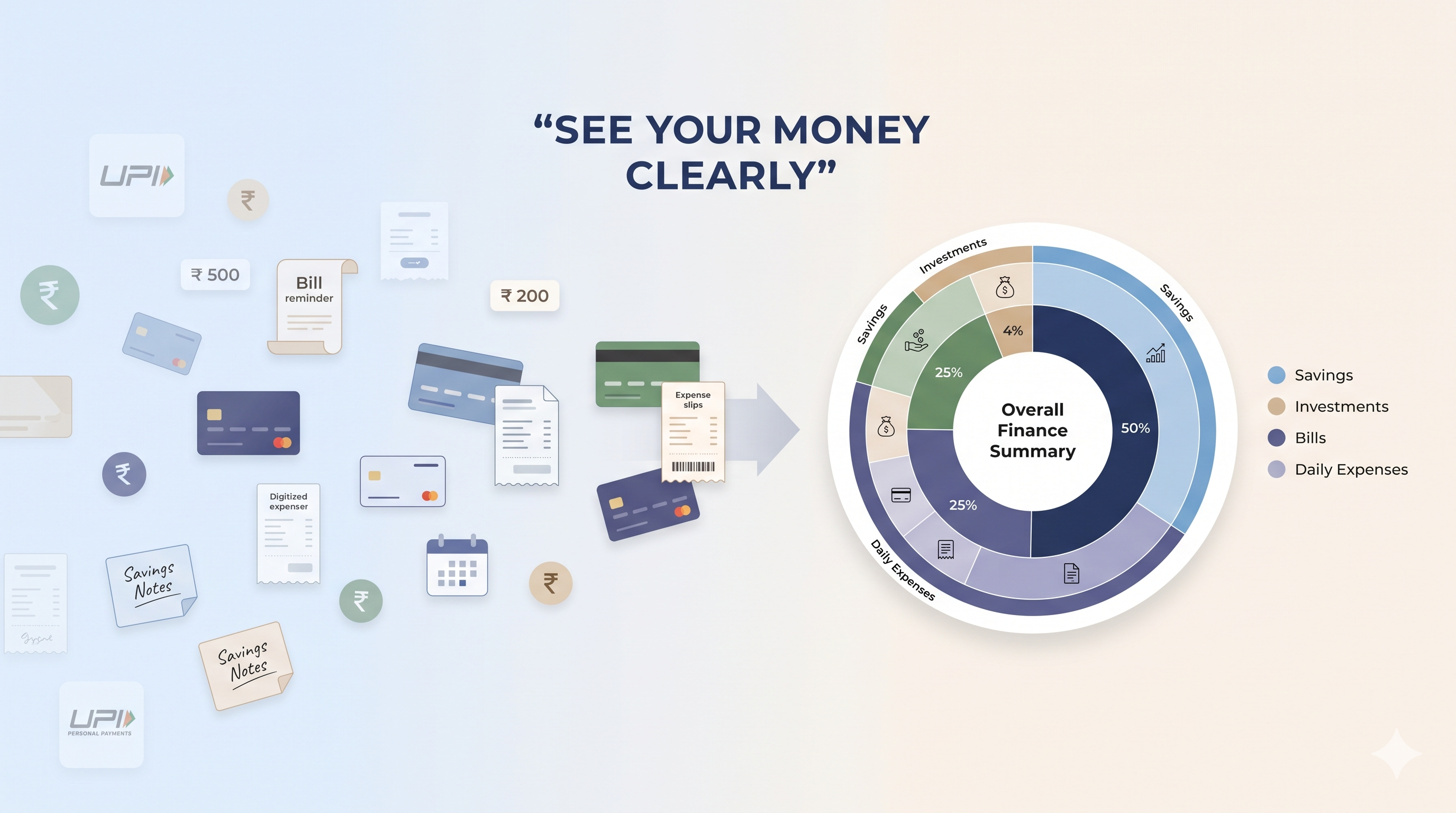
Managing money from memory feels easy—until it does not
Many people manage their money without any proper system. They remember roughly how much salary came in, how much rent is due, whether a credit-card bill is pending, and whether there is enough money in the bank for the rest of the month.
This may work when life is simple. But as UPI payments, cash expenses, loans, subscriptions, cards, family spending, savings goals and multiple bank accounts enter the picture, remembering everything becomes difficult. A personal finance tracker is not about becoming overly strict with money. It is about replacing guesswork with clarity.
Key takeaway: You do not need to remember every rupee perfectly. You need a simple way to see where money comes from, where it goes, what is due next, and what remains available for your real priorities.
The real problem is not poor memory
Most people do not lose track of money because they are careless. They lose track because modern money moves through too many places.
A typical month may include salary credited to one bank account, UPI payments from another account, groceries paid through a credit card, an EMI deducted automatically, cash used for local travel, subscriptions charged in the background, and a family member asking for money for an important expense.
None of these transactions may seem large on their own. But when they are spread across different payment methods, it becomes hard to answer simple questions such as:
- How much did I actually spend this month?
- How much money is still free to use?
- Which bills are due before the next salary?
- Did I save anything meaningful, or did the money simply disappear?
- How much do I already pay every month towards EMIs and credit cards?
- Is my bank balance showing real financial comfort, or is it reserved for upcoming commitments?
Memory can store broad ideas. It is not designed to maintain a complete and accurate financial record over many months.
A simple example
Suppose Priya earns ₹52,000 per month. She knows her rent is ₹13,000, her EMI is ₹7,500, and she usually spends around ₹8,000 to ₹10,000 on food, travel and daily needs.
But during the month, several smaller payments happen: ₹349 for a subscription, ₹1,200 for online shopping, ₹900 for medicines, ₹1,500 for family needs, ₹2,400 for a credit-card bill, and many small UPI payments. At month-end, Priya may feel that she “did not spend that much.” Her bank balance may tell a different story.
This is exactly where organised tracking becomes useful. It brings scattered financial activity into one understandable view.
Why managing money in your head becomes difficult over time
1. Small expenses become invisible
A ₹100 payment may not matter much by itself. But several small payments for snacks, transport, quick online purchases, food delivery, digital subscriptions and convenience spending can become a noticeable amount by the end of the month.
When these expenses are not recorded, they often feel “too small to track.” Yet they are exactly the expenses that are easiest to forget and hardest to review later.
2. Different payment methods hide the full picture
Cash, UPI, debit cards, credit cards, bank transfers and automatic deductions all feel different while paying. But they still affect the same personal financial position.
For example, a credit-card purchase may not reduce your bank balance immediately. That does not mean the money is freely available. It simply means the payment will appear later in the form of a bill.
3. Upcoming obligations are easy to underestimate
People often check their account balance and assume they are financially comfortable. But that balance may already need to cover rent, school fees, insurance, an EMI, electricity bills, a credit-card payment or an upcoming family event.
Without seeing these commitments together, it is easy to spend money that was quietly needed for something else.
4. Savings can feel larger than they really are
A person may say, “I have ₹80,000 in the bank.” But part of that money may be reserved for an annual insurance premium, a planned repair, an emergency, a future trip, a school expense or a loan repayment.
A personal finance system helps separate “money available today” from “money that already has a purpose.”
5. Financial decisions become emotional instead of informed
When there is no clear record, decisions are often based on a feeling: “I think I can afford it,” “I think my spending is under control,” or “I think I am saving enough.”
Feelings are useful, but they are not a substitute for financial visibility. A clear record gives you something more reliable to work with.
What a personal finance tracker actually helps you do
A personal finance tracker does not magically create more income. It does not remove your expenses or guarantee savings. Its main value is much simpler: it helps you understand your own money.
A structured tracker can help you:
- Record income and expenses in one place.
- See how much is spent across important categories.
- Understand the difference between available money and money reserved for upcoming needs.
- Keep an eye on EMIs, loans, credit cards and regular bills.
- Review savings, goals, emergency funds and investments in the context of your overall finances.
- Look back at previous months instead of depending on memory.
- Make future decisions with better awareness.
The aim is not to make every day about numbers. The aim is to reduce the number of times you feel surprised by your own finances.
Managing money in your head vs using a tracker
Do you need a tracker if your finances are simple?
Not everyone needs a detailed system immediately. If you have one bank account, no loans, very few monthly expenses and a simple routine, a notebook or basic spreadsheet may be enough for now.
Manual tools can be useful because they are flexible, familiar and easy to start with. A notebook can help build the habit of recording expenses. Excel or Google Sheets can be excellent for custom calculations, one-time planning or people who enjoy working with spreadsheets.
But it may be time to consider a more structured approach when you regularly face any of the following situations:
- You are unsure where your salary went before the month ends.
- You use multiple bank accounts, payment methods or credit cards.
- You have loans, EMIs or recurring bills to manage.
- You find it hard to maintain a spreadsheet consistently.
- You want to track savings goals, emergency money or planned expenses.
- You feel anxious before checking your account balance.
- You want to understand your overall financial position, not just one transaction at a time.
A useful rule of thumb
The moment money management starts depending on reminders, rough estimates, screenshots, chat messages and mental calculations, it may be time to create a more organised system.
You do not need to track everything perfectly from day one
One reason people avoid financial tracking is that they imagine it will take too much effort. They think they must enter every transaction perfectly, create many categories and fix all old financial records before they can begin.
That is not necessary. A better approach is to start small and make tracking useful from the beginning.
A practical starting method
- List your main bank accounts, wallets, cards and cash balances.
- Track only important categories first, such as home, food, travel, bills, loan payments and savings.
- Record major monthly income and fixed commitments before focusing on smaller spending.
- Review your finances once a week instead of waiting until month-end.
- Add more detail only when it helps you make a better decision.
Financial tracking should make life easier, not create another burden. The best system is one that you can realistically continue.
How clearer tracking can change everyday decisions
When your financial picture is organised, even ordinary choices become easier to evaluate.
For example, before buying a new phone, you can look beyond your current bank balance and consider upcoming payments. Before agreeing to a new EMI, you can see existing repayment commitments. Before planning a trip, you can check whether the money is truly available or already needed for another purpose.
Clear records can also help you notice patterns. Perhaps eating out has increased over the last three months. Perhaps annual expenses arrive every year but still feel unexpected. Perhaps you are saving regularly but keeping all savings in one place without assigning them to different goals.
These observations do not tell you what to do. They simply give you a better starting point for deciding what matters most to you.
A practical next step
Choose one recent month and write down your income, fixed bills, loan or card payments, major expenses and savings. You do not need perfect records. Even this first review can reveal where your money is actually going.
Where RollingCash fits into the picture
RollingCash is built for people who want a more organised view of their personal finances without treating money management like a complicated accounting project.
Instead of relying only on memory, scattered notes or disconnected payment histories, a structured finance tracker can help bring income, expenses, accounts, budgets, cash flow, loans, credit cards, savings goals and financial reports into a clearer everyday view.
The purpose is not to judge your spending or tell you how to live. It is to help you understand your financial situation well enough to make calmer, more practical decisions.
The goal is clarity, not perfection
You do not need to become an expert in finance overnight. Start by understanding your own money better. When you can clearly see what you earn, spend, owe, save and plan for, managing money becomes less about guessing and more about making informed choices.
Disclaimer: This article is for general education and personal financial tracking. It is not investment, tax, or financial advice.