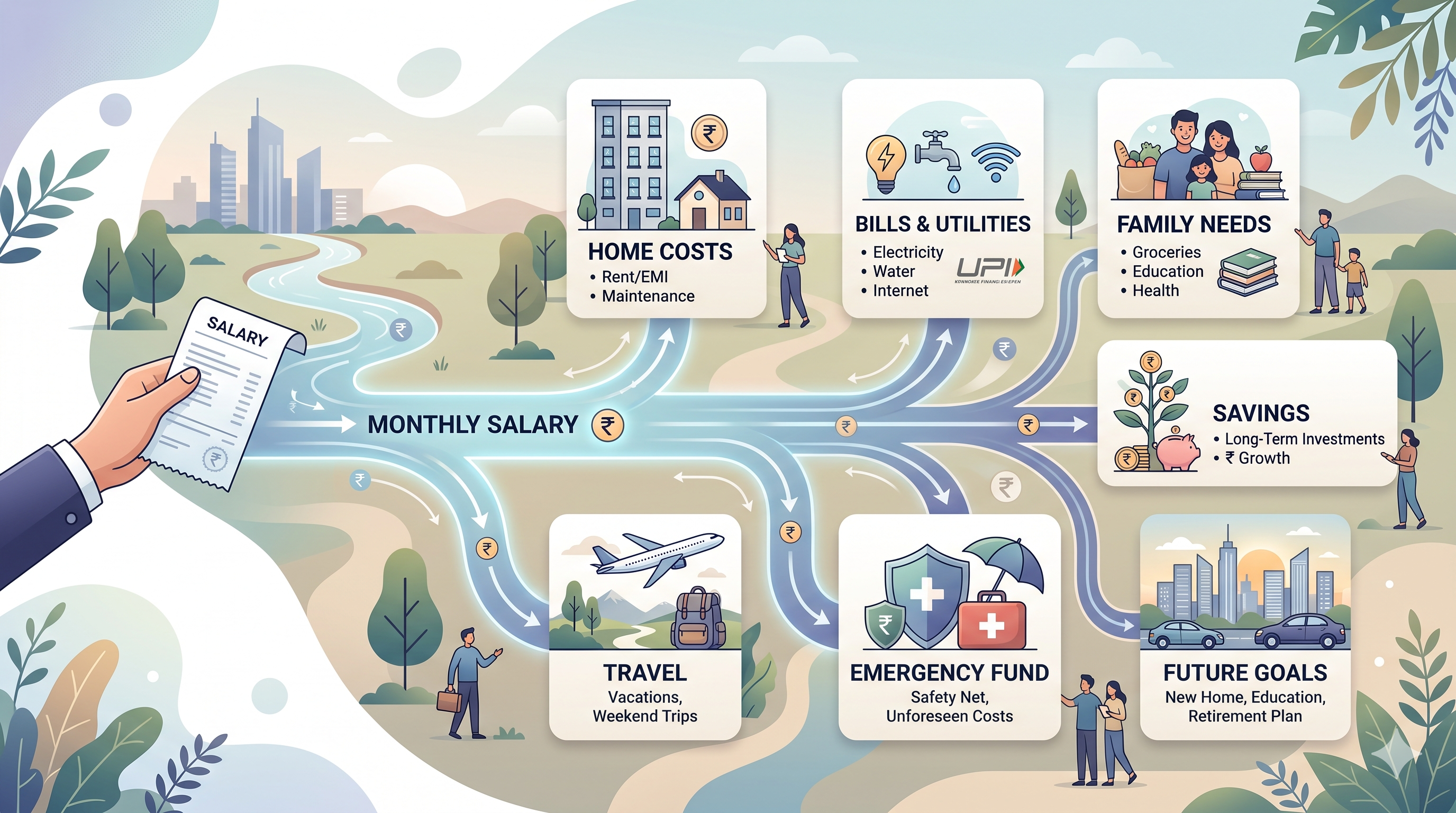
A salary brings stability, but it does not automatically create clarity
For many salaried employees, payday brings a sense of relief. Salary has arrived, important bills can be paid, and the month feels manageable again.
But after a few weeks, the same questions often return: Where did the salary go? How much can I actually spend? Is there enough for the credit-card bill? Did I save anything this month? Can I afford an unplanned purchase before the next salary arrives?
Key takeaway: A salary gives you a regular income cycle. Personal finance tracking helps you see how that income moves through bills, spending, savings, goals and future commitments before the month becomes unclear.
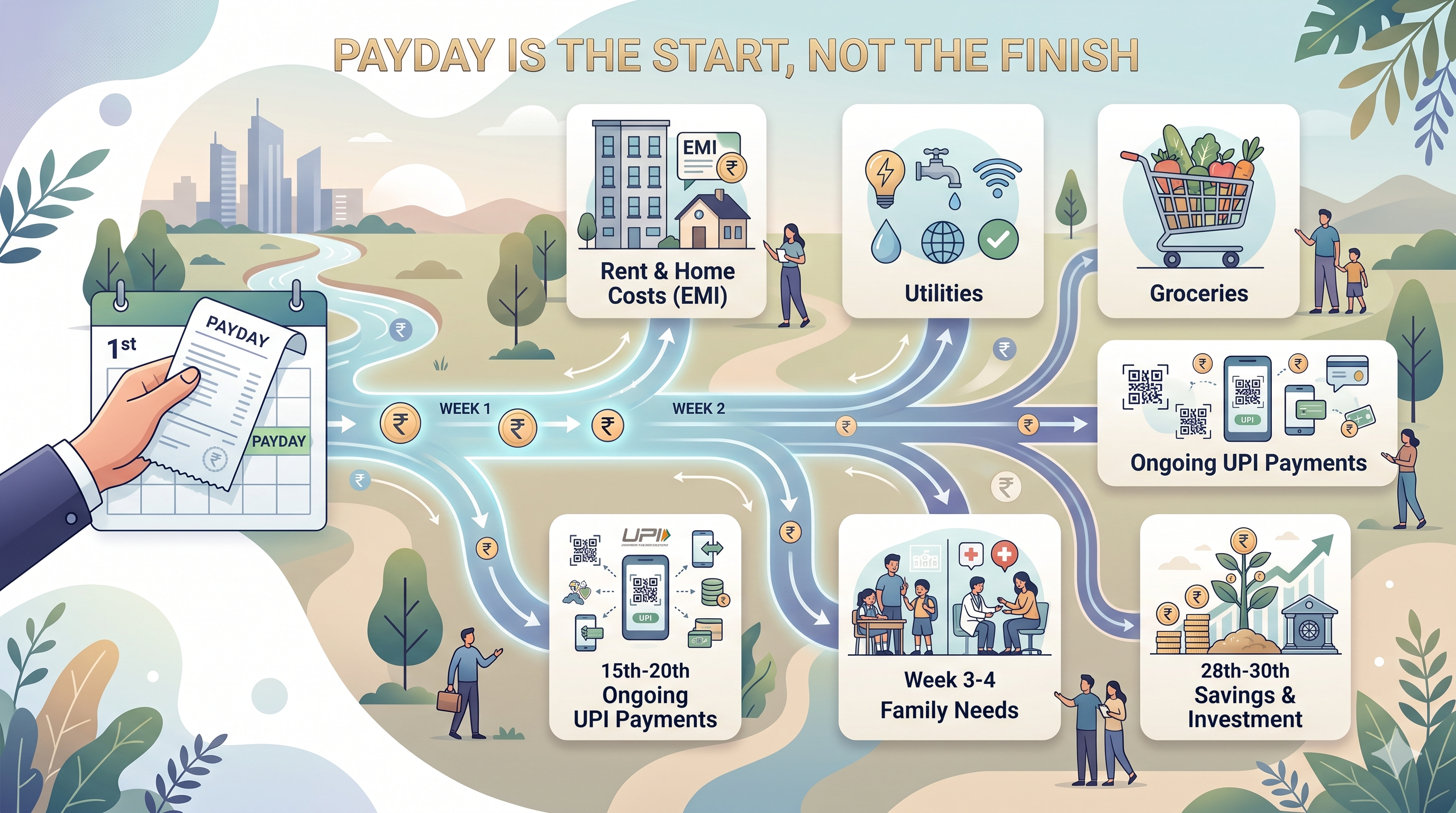
A salaried income may feel predictable because it usually arrives on a fixed date. However, the expenses around it do not always follow one simple pattern. Rent may be due at the beginning of the month. An EMI may be deducted automatically. Grocery spending may happen every few days. UPI payments may occur several times a day. A credit-card bill may be due in the middle of the month, while an insurance payment or family expense may arrive unexpectedly.
That is why financial tracking is not only about recording expenses. It is about understanding the full monthly salary cycle: what has come in, what is already committed, what is being spent day to day, what needs to be saved, and what may be required before the next payday.
Why personal finance tracking matters for salaried employees
When income comes regularly, it is easy to assume that money management will naturally stay under control. But a fixed salary can create a false sense of certainty. You may know your salary amount, yet still not know whether your current spending and commitments fit comfortably within it.
For example, a person earning ₹60,000 per month may have enough income to cover regular living costs. But that income may already have many jobs: rent, household expenses, transport, loan repayments, subscriptions, insurance, support for parents, savings, emergency money and personal goals.
The problem is not necessarily overspending. Sometimes money feels tight because multiple valid commitments are competing for the same salary. When these commitments are not visible together, even a good salary can feel confusing.
A simple example
Suppose Anjali receives ₹55,000 in hand every month. Her fixed commitments include ₹14,000 for rent, ₹6,500 for an EMI, ₹3,000 for insurance and subscriptions, and ₹5,000 for regular family needs.
Her remaining money still has to cover groceries, travel, UPI payments, medical needs, occasional shopping, savings and any unexpected expense. Without a clear monthly view, Anjali may only notice the pressure when her account balance becomes lower than expected.
Personal finance tracking helps turn this unclear month-end feeling into something more practical. Instead of asking, “Where did all the money go?”, you can begin asking better questions: “Which commitments took the biggest share? What is still due? How much is genuinely available? What needs to change next month?”
A salary is predictable, but the month around it is not always predictable
Salaried employees often plan around one salary date, but money does not stop moving after payday. Your financial position changes throughout the month.
There may be a planned expense such as a bill or EMI. There may also be a necessary but irregular expense such as medicines, vehicle repair, school requirements, a family event or travel. Even small expenses can build up through food delivery, local travel, subscriptions, online purchases and quick UPI payments.
That is why checking the bank balance alone is not enough. A bank balance tells you how much money is currently sitting in an account. It does not automatically tell you how much of that money is already needed for upcoming obligations.
Available money is not always the same as your account balance.
Available money = Current account balance − money already needed for upcoming commitments
For example, if your account balance is ₹28,000 but ₹12,000 is needed for rent, ₹6,000 is due on a credit card and ₹3,000 has been kept aside for insurance, your actual flexible money is much lower than ₹28,000.
Seeing this difference early can help you avoid accidental overspending, unnecessary stress and last-minute dependence on credit.
Start with your in-hand salary, not only your CTC
When planning personal finances, the most useful number for your monthly routine is usually the amount that actually reaches your bank account after regular deductions. This is often called your in-hand or net salary.
Your CTC may include several components, benefits or employer-side costs that do not directly become available for everyday spending. For monthly planning, begin with the amount you can actually use during the month.
This does not mean other salary components are unimportant. It simply means your monthly cash-flow plan should be built around the money available to pay bills, manage spending, save for goals and handle real-life needs.
A practical starting point
Use your actual monthly bank credit as the starting point. Then list the commitments that already need a share of that salary before deciding how much is available for flexible spending, savings or new purchases.
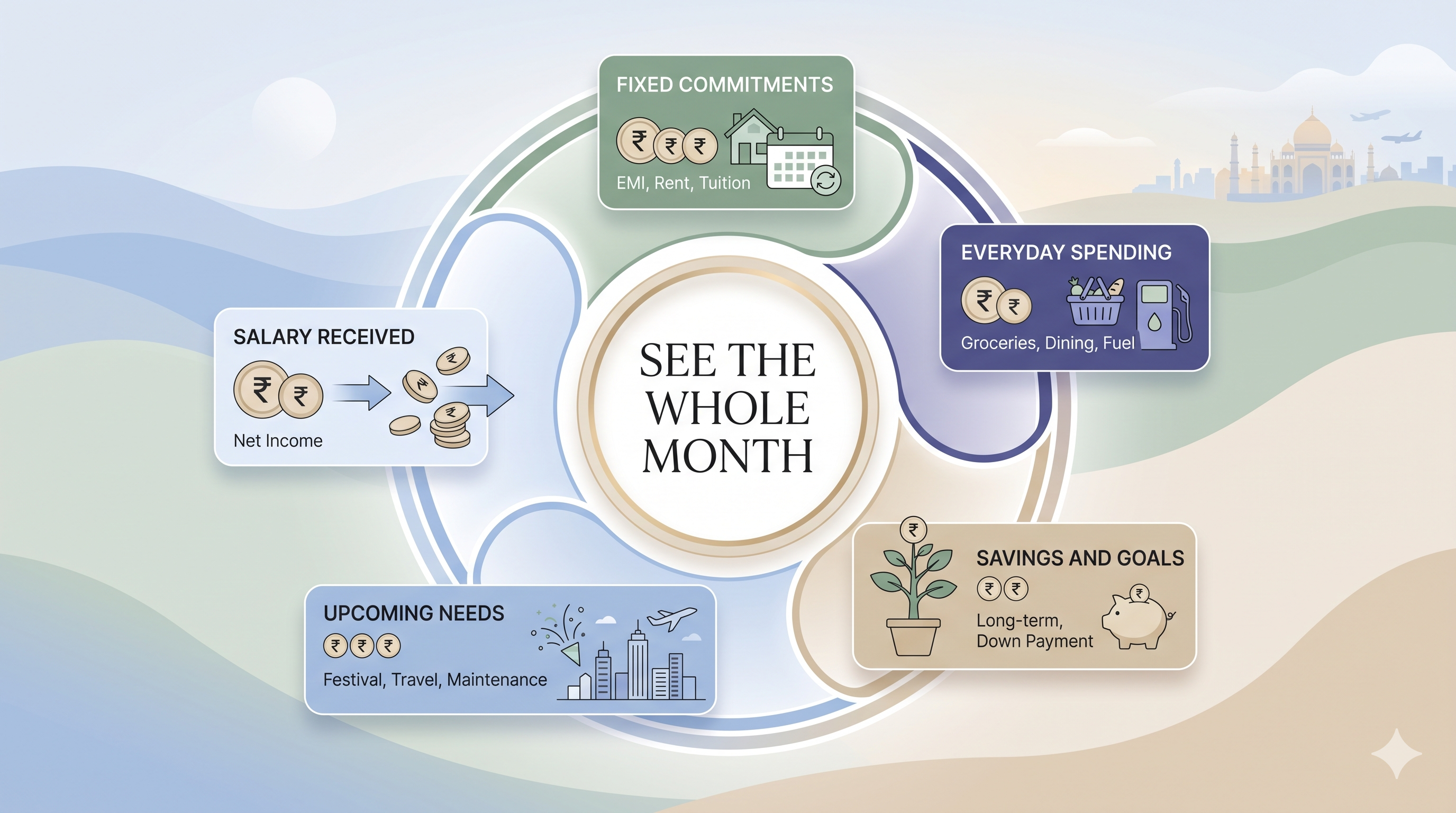
The five parts of a healthy salary-tracking system
A useful salary-tracking routine does not need dozens of categories. It needs a clear view of the financial areas that matter most.
A practical monthly system usually includes:
- Salary received: Your in-hand salary and any other genuine income received during the month.
- Fixed commitments: Rent, EMIs, insurance, school costs, subscriptions, regular transfers and recurring bills.
- Everyday spending: Groceries, travel, food, UPI purchases, household expenses, medical needs and personal spending.
- Savings and goals: Emergency money, planned purchases, future education, travel, home needs or other personal goals.
- Upcoming needs: Bills, annual expenses, family commitments or irregular costs expected before the next salary cycle.
When these five areas are reviewed together, you can see whether your salary is being used intentionally or simply disappearing through scattered transactions.
A sample monthly salary plan for ₹60,000
There is no single correct budget for every salaried employee. Rent, family size, city, responsibilities, loans and personal priorities vary widely. However, a sample structure can help you think through the main parts of your own salary.
This is not a rule or a recommendation for how every person should divide their salary. It is only a way to make all major parts of the month visible. Your own plan may look very different, and that is normal.
Where salaried employees commonly lose track of money
Even with a regular salary, there are a few patterns that can make money difficult to follow.
1. Treating all money in the account as free to spend
This is one of the most common problems. The account balance may look healthy, but some of that amount may already be needed for bills, EMIs, credit-card payments or upcoming family commitments.
Separating upcoming obligations from free-to-use money helps reduce accidental overspending.
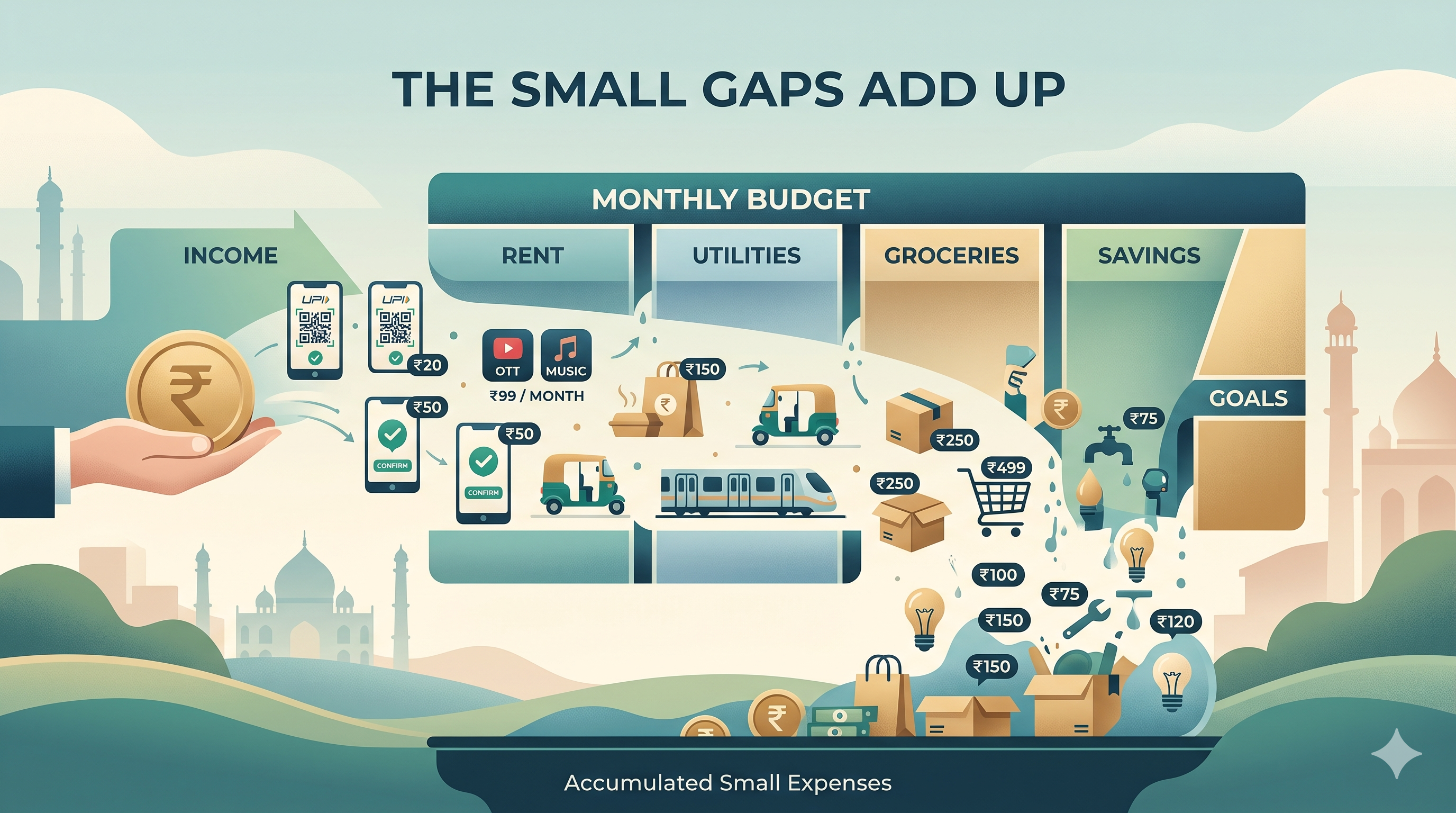
2. Ignoring small and frequent UPI payments
UPI has made everyday payments quick and convenient. However, convenience can also make small spending easy to forget. ₹80, ₹150, ₹249 or ₹500 may not feel significant in the moment, but repeated payments can influence the monthly picture.
The purpose of tracking UPI spending is not to question every small expense. It is to understand the total pattern and decide whether it still fits within your priorities.
3. Remembering the EMI but forgetting the full debt picture
Many people remember their monthly EMI but do not always review the larger impact of loans, credit-card balances and other repayments together. A monthly payment may feel manageable in isolation, but several commitments can reduce flexibility significantly.
Tracking your debt commitments in one place can help you see how much of your salary is already allocated before you make new financial commitments.
4. Treating savings as whatever remains at the end
Saving only from whatever is left at month-end can be difficult because unexpected spending often appears before the month is over. A more intentional approach is to give savings a place in the monthly plan, even if the amount is small.
This does not mean you must follow a rigid formula. It means treating important future needs as part of the current month, not as an afterthought.
5. Forgetting irregular but predictable expenses
Insurance renewals, annual subscriptions, school costs, vehicle servicing, festival expenses and planned travel may not happen every month, but they are still part of real life. When these are ignored until the due date arrives, they can disrupt the salary cycle.
Noting these expenses early gives you more time to prepare rather than forcing a last-minute decision.
How to track salary without making the process exhausting
Financial tracking should not become another full-time task. The goal is not to enter every detail perfectly or create an overly complex budget. The goal is to maintain enough clarity to make useful decisions.
Keep your starting structure simple
- Track income when it arrives.
- Record fixed commitments first.
- Use broad categories for everyday spending instead of creating too many labels.
- Review credit-card purchases before the bill date, not only after the bill arrives.
- Give savings and future needs a visible place in the monthly picture.
- Review your financial position once a week instead of waiting for month-end.
For many people, broad categories are enough at first. For example: home, food, travel, family, bills, debt payments, personal spending, savings and future goals. You can add more detail later only when it helps you understand something important.
A simple monthly review routine for salaried employees
A short review near salary day or at month-end can make a major difference. It gives you a chance to notice the month’s pattern before the next one begins.
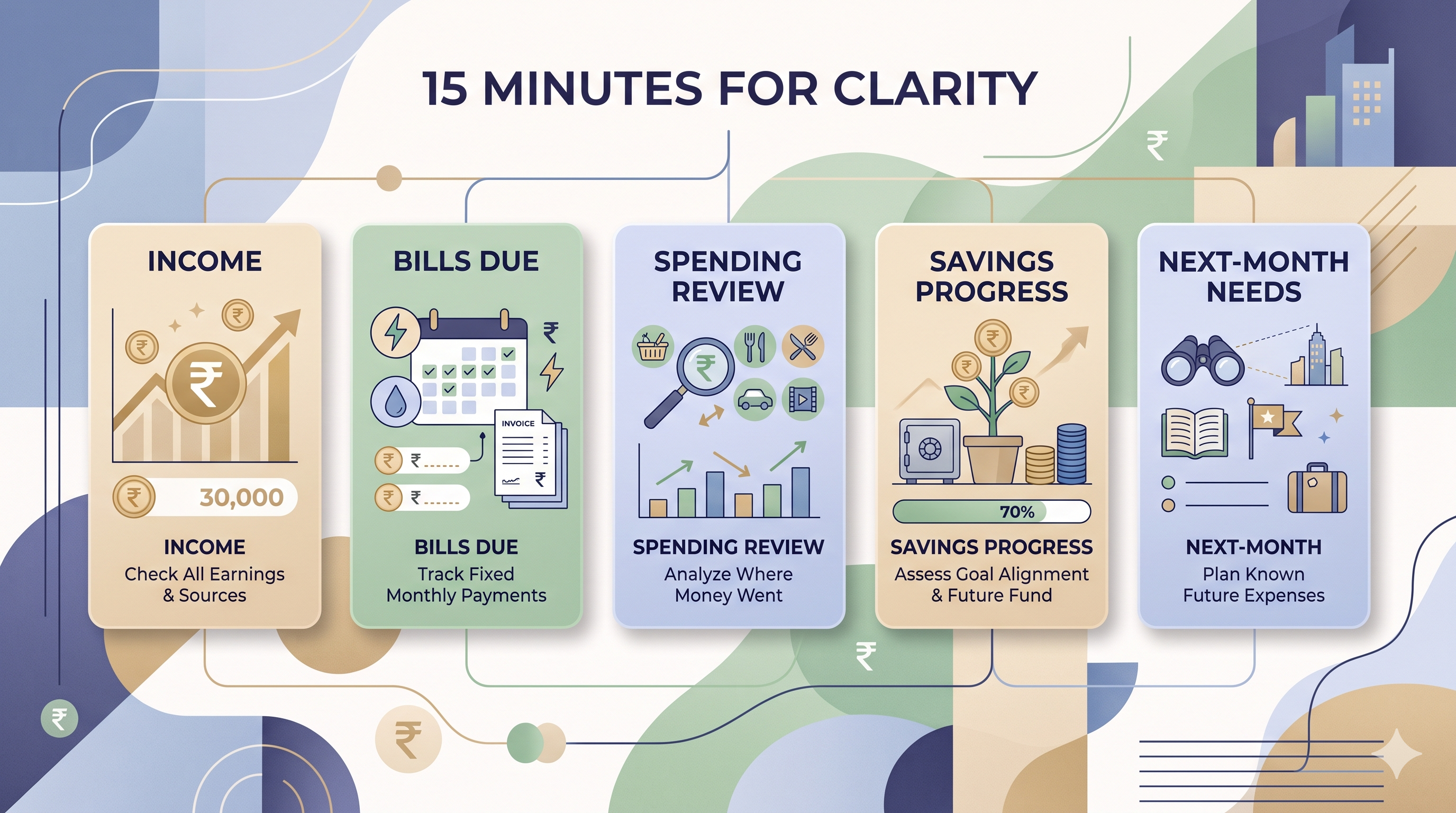
A 15-minute monthly check-in
- Confirm the salary and other income received during the month.
- Review fixed bills, EMIs and credit-card payments due before the next salary.
- Look at spending categories that felt higher or lower than expected.
- Check whether savings, emergency money or a personal goal received a contribution.
- Write down one or two irregular expenses expected next month.
- Decide whether any small adjustment is needed for the upcoming salary cycle.
This review does not need to feel like a financial audit. It is simply a short pause to understand what happened and prepare for what comes next.
What to do when you receive a salary hike, bonus or arrears
An increase in income can create a good opportunity to improve your financial position. But it can also disappear quickly when lifestyle costs rise without a plan.
There is nothing wrong with enjoying a higher income or using part of it to improve your daily life. The helpful step is simply to decide in advance how much of the additional money will go towards present needs, savings, emergency money, existing obligations or personal goals.
A one-time bonus or arrears payment can also feel larger than it actually is because it arrives separately from the regular salary. Before spending it, consider whether there are overdue obligations, upcoming irregular expenses or important goals that would benefit from a planned contribution.
A balanced way to handle extra income
You can divide an increase or one-time payment into a few clear purposes: one part for immediate enjoyment or lifestyle needs, one part for planned future expenses, and one part for savings or financial priorities. The exact amounts depend on your own situation.
When a structured personal finance tracker may help
A notebook, Excel file or Google Sheet can work well for many salaried employees, especially when finances are simple and the habit of updating records is strong.
However, a structured finance tracker can become useful when your financial life includes multiple accounts, UPI payments, cards, loans, budgets, savings goals, investments or family responsibilities that are difficult to understand through separate records.
RollingCash is designed to help users organise personal financial areas in a connected way. Instead of relying only on memory, screenshots, multiple spreadsheets or a quick bank-balance check, a structured tracker can help you see income, expenses, accounts, cash flow, loans, credit cards, savings goals and financial reports more clearly.
The purpose is not to judge your spending or force a strict lifestyle. It is to help you understand what your salary is already doing, what is coming next and where you may want to make a more informed decision.
A practical first step for this month
Start with your latest salary. List the fixed commitments that must be covered before the next payday, estimate your everyday spending categories, and note one future expense that you do not want to be surprised by. This simple exercise can give you more clarity than checking your account balance alone.
A salary feels more useful when you can see its direction
The aim of personal finance tracking is not to control every rupee or remove all flexibility from life. It is to reduce avoidable surprises. When you know what has come in, what is already committed, what is being spent and what you are building towards, salary management becomes calmer and more intentional.
Disclaimer: This article is for general education and personal financial tracking. It is not investment, tax, or financial advice.