A good income does not always feel like financial comfort
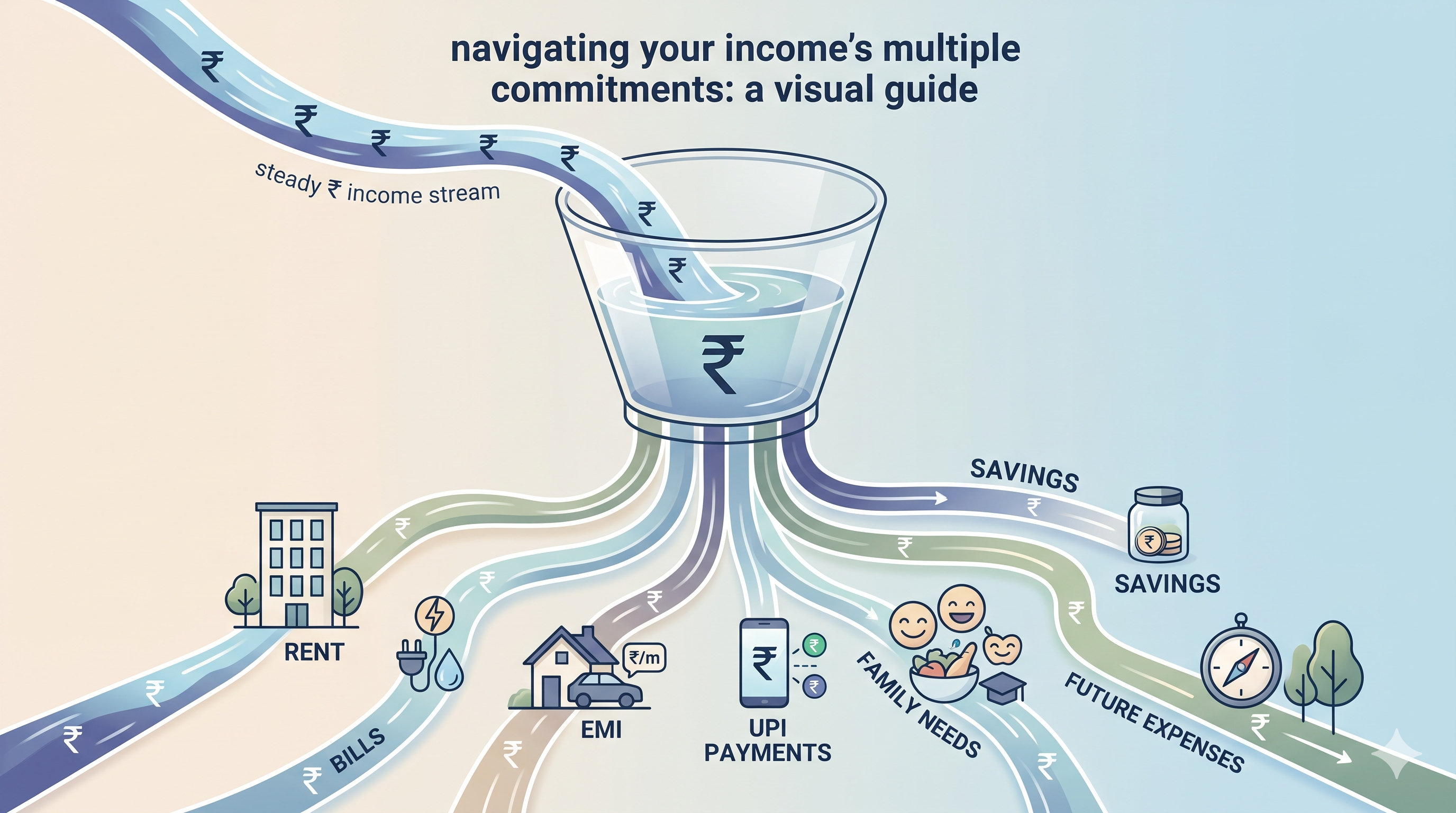
Many people earn a reasonable salary, run a business, receive freelance income or have multiple household earners—and still feel unsure about their financial situation.
The question is often not, “Am I earning enough?” It is, “Why does my money still feel difficult to understand?” Salary may come in on time, bills may be paid, and life may look stable from outside. Yet by the middle or end of the month, it can become unclear where the money went, what is still due, and how much is actually available.
Key takeaway: Earning more can improve your options, but financial clarity comes from knowing how income, spending, obligations and goals connect—not from income alone.
It is easy to assume that people lose track of money only when their income is low. In reality, money can become harder to manage as income rises because there are often more responsibilities, more payment methods and more financial decisions happening at the same time.
This is not a sign of failure. It is usually a sign that the old way of managing money—memory, rough estimates, bank-balance checks and occasional notes—is no longer enough for the complexity of everyday life.
Earning more and feeling in control are not the same thing
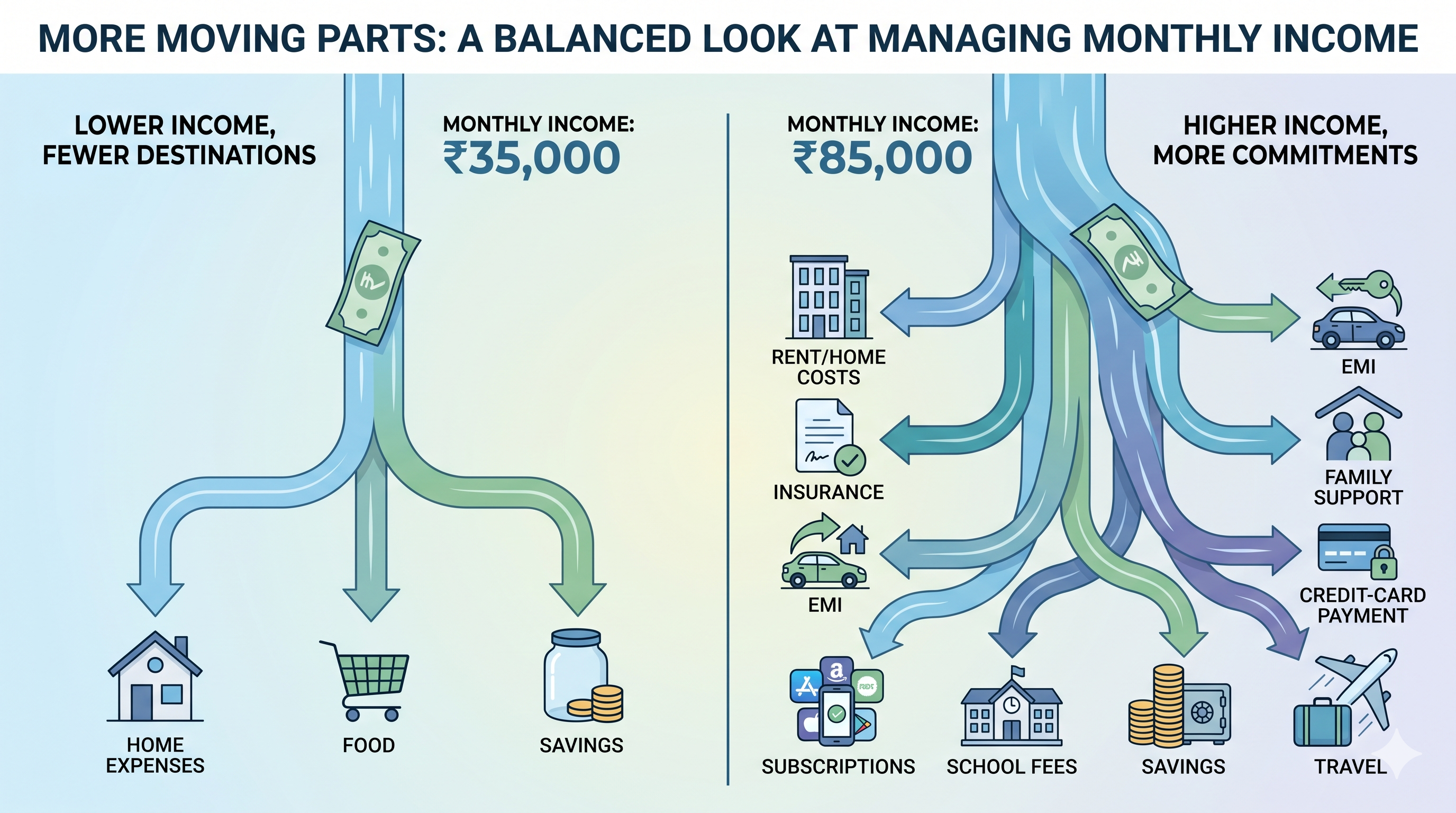
A higher income can make life more comfortable. It can also bring more financial responsibilities. A person earning ₹30,000 per month may have a simple pattern: rent, food, travel, mobile recharge and some savings. A person earning ₹80,000 may have more room to spend, but may also have an EMI, insurance payments, family support, school fees, credit cards, subscriptions, investments, travel plans and larger household costs.
In other words, higher income may increase the number of places where money goes.
A relatable example
Rohit earns ₹75,000 each month. He feels that he should be financially comfortable because he earns more than he did a few years ago. But every month, ₹18,000 goes towards rent, ₹9,500 towards an EMI, ₹4,000 towards insurance and subscriptions, ₹7,000 towards groceries and home expenses, ₹5,000 towards family needs, and several payments happen through UPI and credit cards.
By month-end, Rohit may still wonder why he has not built the savings he expected. The issue may not be a single large unnecessary expense. It may simply be that the full picture is spread across many small and valid commitments.
Without a clear record, it becomes difficult to distinguish between three different things:
- Money that has already been spent.
- Money that is still in the bank but already needed for something soon.
- Money that is genuinely free for a new purchase, saving goal or investment decision.
When all three are mixed together, even a healthy income can feel confusing.
The hidden reasons money becomes difficult to track
1. Small payments do not feel important at the moment
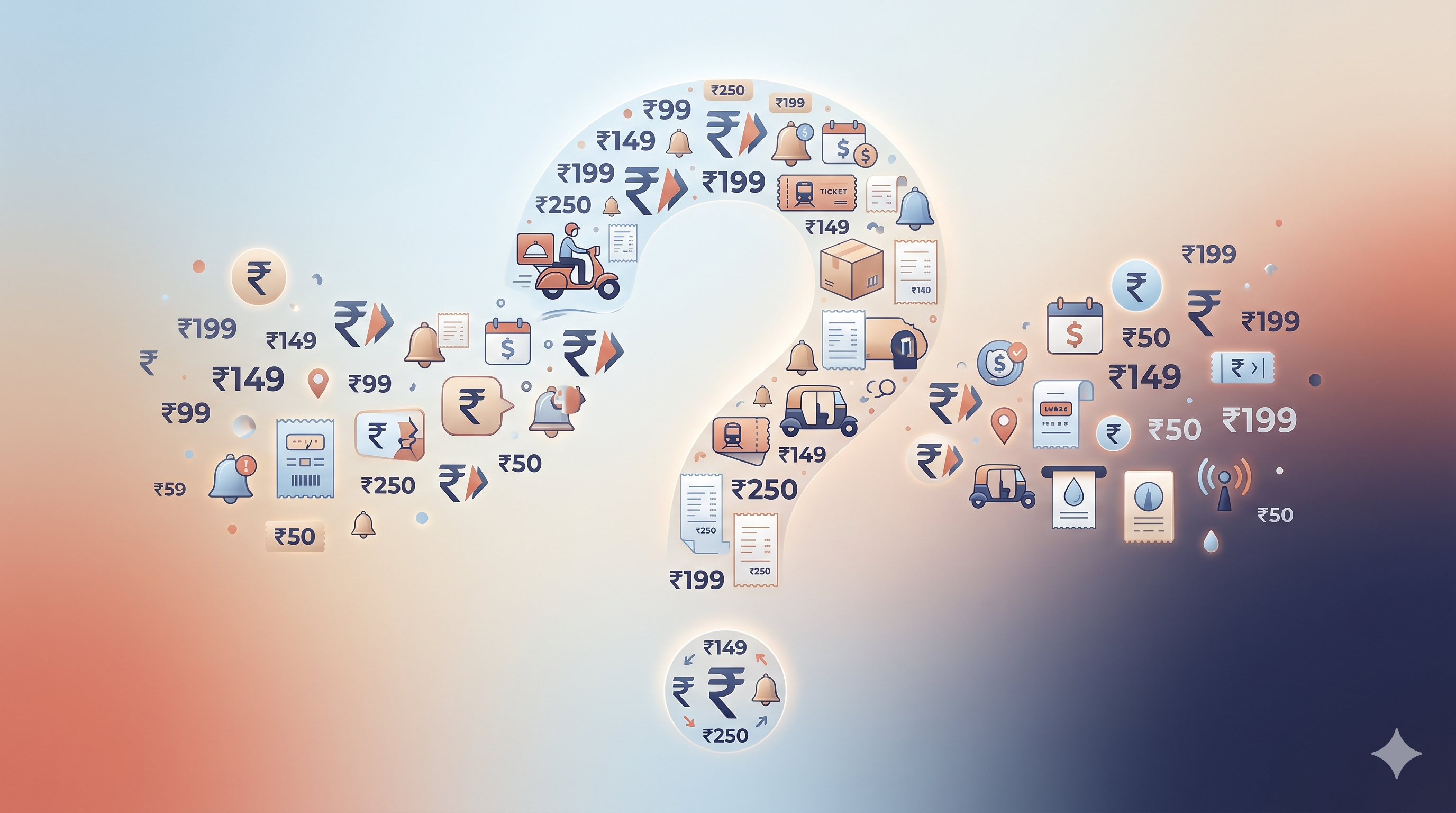
A ₹120 payment for snacks, ₹249 for a subscription, ₹350 for local travel, ₹499 for a quick online purchase or ₹700 for food delivery may not feel like a major financial event. Most people do not think about recording each one.
But when many such expenses happen over a month, the total can be meaningful. Small payments are especially easy to forget because they are spread across UPI, cards, cash and automatic deductions.
The problem is not that small spending is always wrong. The problem is that unreviewed spending is difficult to understand. You may be happy with the amount you spent once you see it clearly. Or you may decide that some part of it no longer reflects your priorities. Either way, you need visibility before you can make that decision.
2. Bank balance creates a false feeling of available money
Checking your bank balance is useful, but it does not show your complete financial position. Suppose your account shows ₹45,000 today. At first glance, that may feel comfortable. But ₹15,000 may be needed for rent, ₹8,000 for a credit-card bill, ₹5,000 for an EMI, and ₹7,000 may be reserved for an upcoming annual expense.
Your balance is ₹45,000, but your genuinely flexible money is much lower.
Available money is not always the same as account balance.
Available money = Current balance − money already needed for upcoming commitments
This is why people sometimes feel financially fine at the start of the month and suddenly feel pressured later. The money was present, but it already had important jobs to do.
3. Credit-card spending feels separate from everyday spending
Credit cards can make payments convenient, but they can also separate the purchase from the moment the money leaves your bank account. You may buy groceries, book tickets, pay for online shopping or renew a service using a card. The actual payment happens later when the bill is due.
This can make spending feel less immediate. If card purchases are not included in your wider financial view, you may see a healthy bank balance and forget that a significant bill is waiting.
The goal is not to avoid credit cards. The goal is to recognise card spending as a real financial commitment at the time of purchase, not only when the payment date arrives.
4. Irregular expenses keep arriving as surprises
Many expenses are not monthly, but they are still predictable. Insurance premiums, vehicle servicing, school fees, festival spending, home repairs, medical costs, annual subscriptions, gifts and travel are common examples.
These expenses often feel unexpected because they do not appear in the normal monthly routine. But they are not truly random. They are part of life, and they deserve a place in financial planning.
When people do not prepare for irregular expenses, they may use savings, delay another goal or rely on credit at the last moment. A better approach is to recognise these future needs in advance and gradually set aside money for them over time.
5. Income increases, but spending patterns change quietly
As income rises, lifestyle changes are normal. You may move to a better home, choose more convenience, support parents, upgrade transport, enrol children in new activities, travel more often or pay for services that save time.
There is nothing automatically wrong with this. The difficulty begins when spending grows silently and no one checks whether the new pattern still leaves enough space for savings, emergency needs and future goals.
A person may believe, “I earn more now, so I should save more.” But if spending and commitments also rise, savings may not grow at the same pace.
6. Money is managed separately instead of as one connected picture
One person may maintain a bank-account balance in their head, a credit-card reminder on their phone, a loan calculation in an old spreadsheet, investment details in another app, and household expenses in chat messages or paper notes.
Each record may be useful on its own. But when these pieces are disconnected, it is difficult to see the complete financial position.
Financial clarity improves when income, expenses, debts, savings and future commitments are reviewed together. You do not need an accounting degree. You simply need one connected view that makes your everyday financial reality easier to understand.
What money confusion can look like in real life
A simple way to regain control
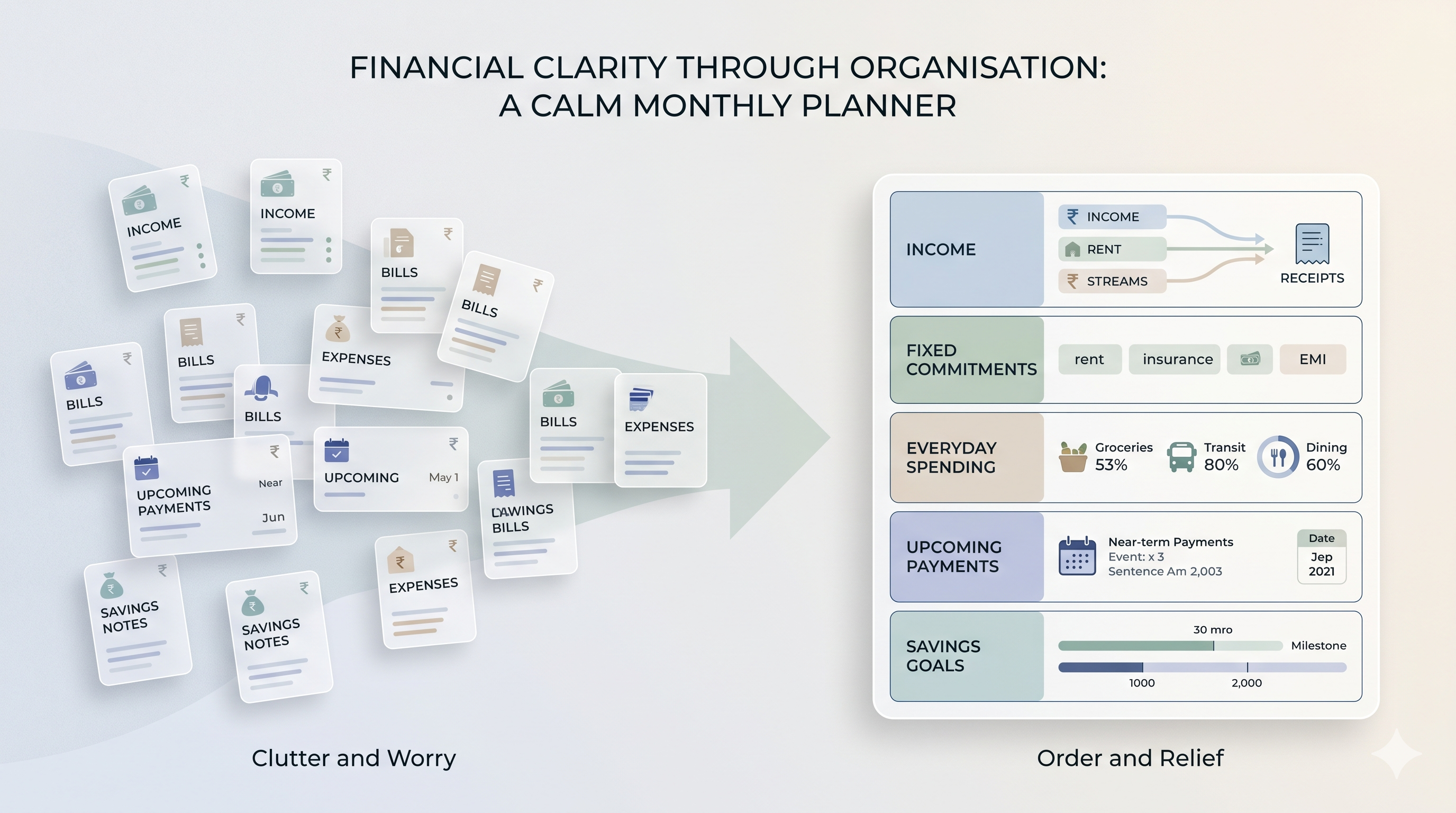
You do not need to rebuild your entire financial life in one weekend. Start by creating a clearer picture of the money that already moves through your life.
Try this 15-minute monthly review
- Write down all income received during the month.
- List fixed commitments such as rent, EMIs, insurance, school costs and subscriptions.
- Estimate or record everyday spending, including UPI, cash and credit-card purchases.
- Note every payment that is still due before the next income date.
- Check how much money is available after those obligations.
- Decide what part of the remaining amount should go towards savings, emergency needs or a specific goal.
The first review may not be perfect. That is completely fine. The purpose is not to produce a flawless report. The purpose is to see your actual financial picture more clearly than before.
When memory, notes or a spreadsheet may still be enough
Managing money manually is not always a bad idea. A notebook, Excel file or Google Sheet can work well for people with simple finances, few transactions and a consistent habit of reviewing records.
Manual methods are especially useful when you want flexibility, prefer writing things down or need a custom calculation for a specific goal. They can also be a good starting point for someone beginning to track money for the first time.
However, a more structured finance tracker may become useful when you regularly manage multiple accounts, credit cards, loans, savings goals, investments or household expenses. It can reduce the effort of keeping separate records and make it easier to review your finances as one connected picture.
A balanced approach works best
You do not need to abandon your current method suddenly. Start with the system you can maintain. If your existing notes or spreadsheet stop giving you clarity, move gradually towards a more organised personal-finance setup.
How RollingCash can help bring the pieces together
RollingCash is designed for people who want to understand their financial situation without relying only on memory, screenshots, scattered notes or rough monthly guesses.
A structured personal-finance view can help you organise income, expenses, accounts, budgets, cash flow, loans, credit cards, investments, savings goals and financial reports in a more understandable way. The value is not in tracking for the sake of tracking. The value is in being able to make day-to-day decisions with a clearer view of what your money is already doing.
For example, before making a large purchase, you can consider upcoming commitments. Before taking a new EMI, you can review your existing repayment responsibilities. Before feeling disappointed about savings, you can understand whether irregular expenses or small recurring payments are affecting your progress.
Start with clarity, not restriction
The first goal is not to cut every small expense or follow a strict financial rule. Start by seeing your income, commitments, spending and upcoming needs clearly. Once you understand the picture, you can decide what changes make sense for your own life.
A good income becomes more useful when you can see its direction
Financial confidence does not come only from earning more. It also comes from knowing where your money goes, what it needs to cover, what you are building towards and what choices are genuinely available to you. Clarity is not about controlling every rupee. It is about reducing avoidable surprises.
Disclaimer: This article is for general education and personal financial tracking. It is not investment, tax, or financial advice.