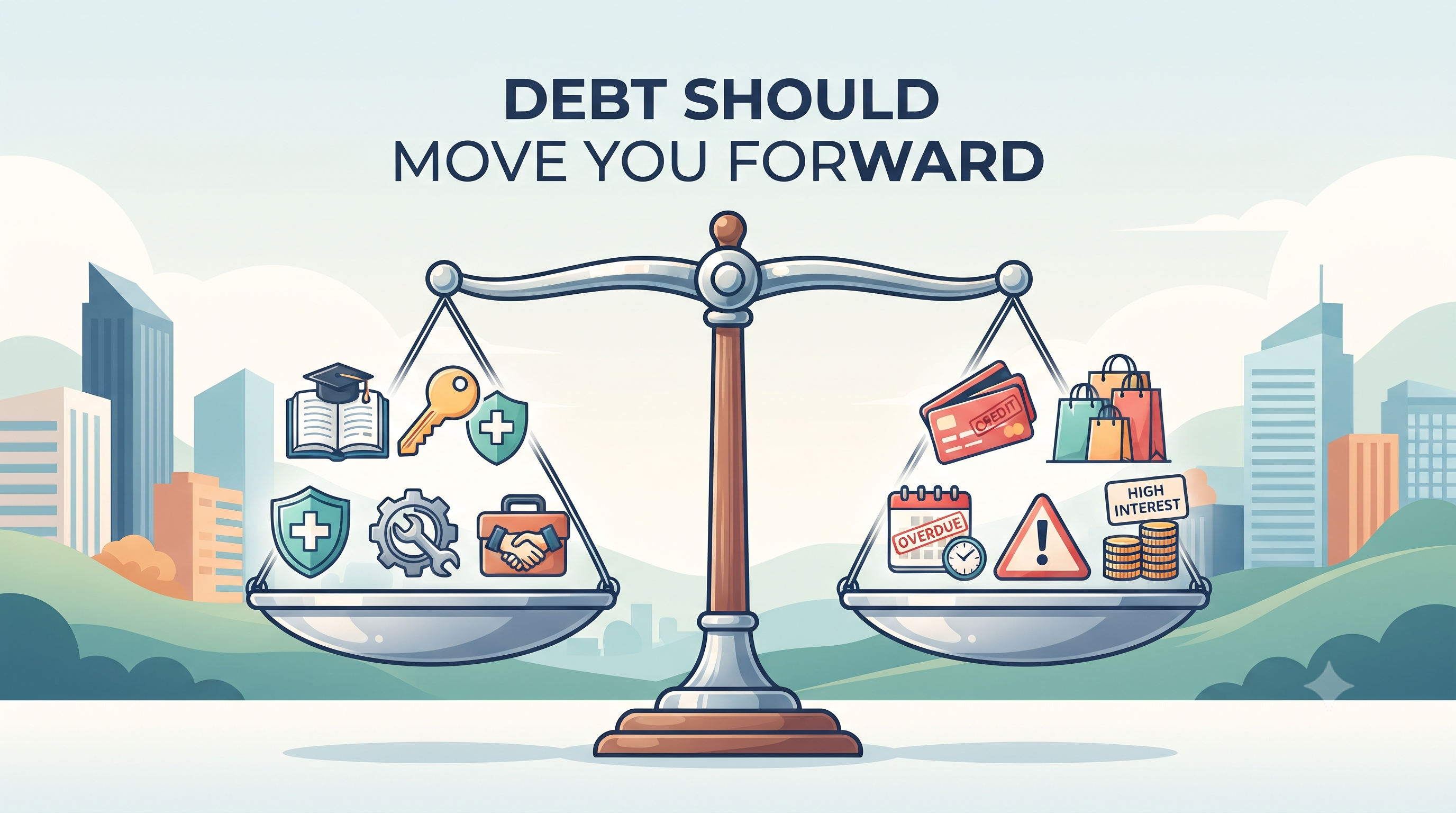
Good Debt and Bad Debt in Simple Words
Debt is not automatically good or bad. What matters is why you borrow, what it costs, and whether you can repay it without creating serious pressure in your life.
A loan used carefully for an important purpose may help you move forward. A loan used repeatedly for unnecessary spending can make future income feel trapped.
Good debt usually supports a useful need with a realistic repayment plan. Bad debt usually creates pressure without adding enough long-term value.
These are not fixed labels. The same type of loan may be manageable for one person and risky for another. A home loan, education loan, personal loan, or credit card can only be judged properly after looking at the full situation.
The Three Questions That Matter Most
Before deciding whether a debt is helpful or harmful, ask these three questions.
1. Why Am I Borrowing?Is it for a necessary, useful, or meaningful purpose? Or is it mainly for an impulse purchase? |
2. What Will It Cost?Do you understand the total repayment, interest, charges, and possible late-payment cost? |
3. Can I Repay It?Will the monthly payment fit comfortably after essential expenses, savings, and existing debt? |
What Is Good Debt?
Good debt is borrowing that may help you build something useful, protect an important need, or improve your future position. It should still have a clear repayment plan.
Good debt does not mean “risk-free debt.” It simply means the borrowing may have a meaningful purpose and may be more manageable when compared with the value it provides.
Common Signs of More Thoughtful Debt
- The purpose is necessary, useful, or likely to improve your life over time.
- You understand the repayment schedule and total cost.
- The monthly repayment fits your real budget.
- You still have room for essential expenses and some savings.
- You are not relying on another loan to repay this one.
- You have thought about what happens if income is delayed or reduced.
Examples of Debt That May Be More Useful
These examples are not automatic approval. They can be useful only when the cost and repayment plan are reasonable for your situation.
What Is Bad Debt?
Bad debt usually refers to borrowing that creates more financial pressure than benefit. It may be used for unnecessary spending, repeated shortfalls, or purchases that you cannot realistically afford.
The problem is not only the loan itself. The problem is when the repayment becomes difficult, expensive, or starts reducing money needed for food, rent, medicine, family responsibilities, savings, and emergencies.
Common Signs of Risky Debt
- You borrow repeatedly for normal monthly spending.
- You take a new loan only to repay an old loan.
- You do not know the total amount you owe.
- You use credit cards for purchases without a plan to pay the bill.
- You accept EMIs because the monthly amount looks small, without checking the full cost.
- You delay essential bills because debt repayments are taking too much income.
- You feel forced to borrow again before your previous debt is under control.
Examples of Debt That Can Become Harmful
Repeated Credit Card Carry-ForwardUsing a card for regular expenses and carrying unpaid balances month after month without a clear repayment plan. |
Impulse EMIsBuying expensive items only because the monthly EMI appears affordable, while ignoring existing loans and bills. |
Borrowing for Everyday SurvivalTaking loans again and again for groceries, rent, basic bills, or routine expenses because monthly cash flow is weak. |
Debt to Maintain LifestyleBorrowing for status purchases, frequent upgrades, expensive celebrations, or spending that does not match your real income. |
The Same Loan Can Be Good or Bad Depending on the Situation
A loan category alone does not decide whether debt is good or bad. The person’s budget, reason for borrowing, repayment capacity, and financial stability matter more.
Example: A Vehicle Loan
A vehicle loan may be more useful when the vehicle is needed for work, family travel, or earning income, and the monthly EMI fits comfortably into the budget.
The same loan may become risky when it is taken only to buy a more expensive vehicle than needed, leaving little money for rent, food, savings, insurance, or emergencies.
The loan product does not decide everything. Your financial situation decides whether the loan supports you or stresses you.
How Debt Affects Your Monthly Life
Every debt repayment becomes part of your monthly cash outflow. Before taking new debt, you need to know what will remain after all essential needs and existing repayments are covered.
Available Money = Monthly Income − Essential Expenses − Existing Debt Repayments
For example, a person earning ₹55,000 per month may think a new ₹4,000 EMI is manageable. But if they already have rent, groceries, school expenses, insurance, fuel costs, credit card dues, and another EMI, the new debt may leave very little room for emergencies or savings.
A Practical Borrowing Check Before Taking New Debt
- List the real reason for borrowing. Be honest about whether it is necessary, useful, or mainly an impulse.
- Check the total repayment. Do not look only at the amount you receive or the monthly EMI.
- Add all existing EMIs and dues. A new EMI should never be viewed alone.
- Keep essential costs protected. Rent, food, medicine, school needs, and insurance should not become difficult because of a new loan.
- Think about emergencies. Ask what happens if your income is delayed, reduced, or interrupted.
- Consider alternatives. Can you delay the purchase, choose a lower-cost option, save gradually, or use a sinking fund instead?
Good Debt and Bad Debt Compared
How to Move Away From Risky Debt
If debt has become stressful, the first step is not shame. It is clarity.
- Write down every outstanding loan, card due, and informal borrowing.
- Record due dates, regular payments, and outstanding balances.
- Avoid taking fresh debt for non-essential expenses.
- Review spending that is creating repeated shortfalls.
- Plan ahead for known future expenses through savings goals or sinking funds.
- Build even a small emergency fund so every urgent expense does not become a loan.
- Focus on steady progress rather than trying to solve everything in one month.
Debt and Your Net Worth
All debt is a liability. That means it reduces your net worth until it is repaid.
Net Worth = What You Own − What You Owe
Reducing debt can improve your overall financial position. Even though money leaves your bank account when you make a repayment, the amount you owe also becomes lower.
Start simple: Before calling any debt good or bad, write down its purpose, total cost, monthly payment, and effect on your daily budget.
A borrowing decision becomes clearer when you can see how it affects today’s needs and tomorrow’s freedom.
The best debt is not simply the cheapest or biggest loan. It is the borrowing that solves a real need without taking away your financial control.
This article is for general education and personal financial tracking. It is not investment, tax, or financial advice.